How to Get Your Business Recommended by ChatGPT (Without Guesswork)
There's no way to buy or submit your way into ChatGPT's answers. Here's what is documented, what reliably helps, and how to measure whether it's working.
You can't pay or submit your way into ChatGPT's recommendations. What you can do is let its search crawler in, say clearly what you do, and get mentioned in places it reads. Then check every couple of weeks whether it names you more often.
That's the whole game. Here's how to do each part.
Recommended is not the same as cited
Cited means ChatGPT links to your page as a source. Recommended means that when someone asks "best bookkeeping tool for freelancers" or "good dog groomer near Sacramento," your name is in the answer.
If you want customers, being recommended is what matters. Someone asking for a recommendation is usually ready to buy. (For the citation side, see our GEO guide.)
What OpenAI actually says
There's no published ranking formula, whatever some blogs claim. OpenAI's help page on ChatGPT search says four useful things:
- Your site needs to allow OAI-SearchBot to be eligible for search results.
- Placement isn't guaranteed. Results are ranked on multiple factors.
- ChatGPT sometimes sends searches to third-party search providers.
- For local questions, it may use the person's approximate location.
Everything else here is good practice, not a promise.
1. Make sure you're not blocking it
This is the one documented requirement, and it's easy to get wrong.
- Open
yourdomain.com/robots.txt. If it blocksOAI-SearchBotor all bots, you've opted out of ChatGPT search. - Check your host or CDN. Some bot-protection settings block crawlers even when robots.txt allows them.
- GPTBot (training) and OAI-SearchBot (search) are separate. You can say no to training and still allow search.
Since ChatGPT leans on partner search engines, it's also worth ten minutes to verify your site in Bing Webmaster Tools and submit your sitemap.
2. Say plainly what you do, for whom, and where
People ask for recommendations in a pattern: what service, for whom, where, roughly what price, and why this one. If your site doesn't spell those out in plain text, there's nothing to match.
Check that your homepage says:
- What you sell, in your customers' words
- Who it's for
- Where you work, if location matters
- A price or starting price
- What makes you different, as a fact, not a slogan
Put it in normal text, not only images or PDFs, and keep it consistent across pages. Organization or LocalBusiness schema helps too. Our free schema generator writes it for you.
3. Be easy to confirm from outside your site
When ChatGPT searches, it reads directories, review sites, "best of" articles and forums, not just your homepage. If the only place saying you're good is your own site, you're easy to skip.
- Keep listings complete and identical: Google Business Profile, Bing Places, Apple Business Connect, plus the directories in your category.
- Ask happy customers for real reviews. Never buy or fake them.
- Send accurate info to writers of the "best X for Y" articles that already rank.
- Answer questions where your customers hang out, as yourself.
4. Answer the questions buyers ask
A page that answers one real buyer question in its first couple of sentences is easy for any AI to use. Good ones to write:
- "How much does [service] cost in [city]?"
- "[You] vs [the competitor people compare you to]," honestly
- "Is [category] worth it for [type of customer]?"
An honest comparison that admits when the other option fits better is more useful, and more likely to get quoted.
5. Measure it like a poll
Ask ChatGPT the same question twice and you can get different names. So don't judge on one answer.
Your measuring checklist:
- [ ] Write 10–20 questions your customers would actually type
- [ ] Run each one a few times with search on
- [ ] Note who gets named, in what order, and which links are cited
- [ ] Repeat every week or two and watch the trend
- [ ] Watch your analytics for visits from chatgpt.com
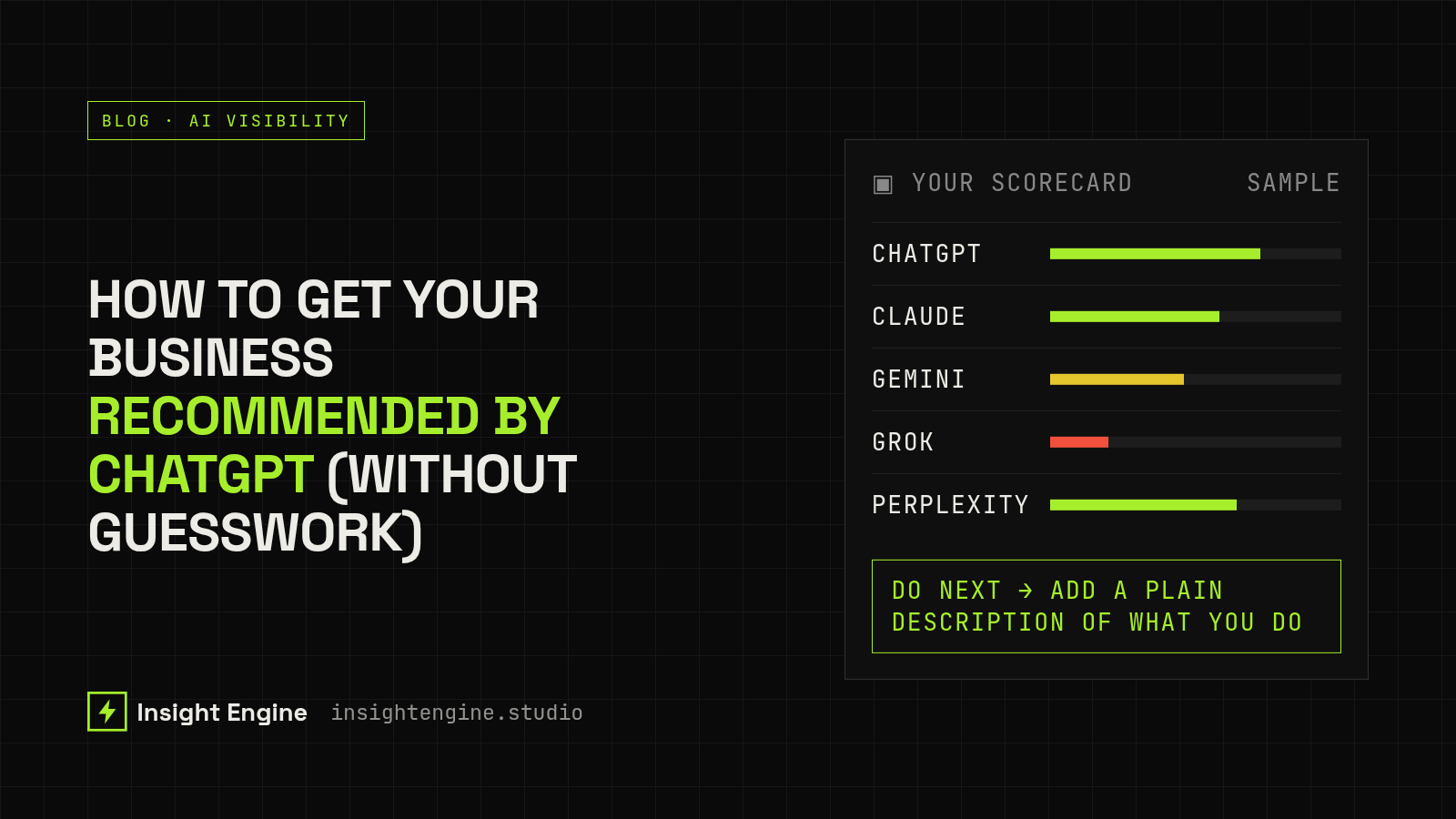
Doing that by hand gets old fast, which is why we built Insight Engine. It asks ChatGPT, Claude, Gemini, Grok and Perplexity the questions your customers ask, shows how often each names you and who it names instead, and gives you the fixes most likely to help.
Get your free AI Visibility Score → No account needed for the free check.
FAQ
Can I pay to be recommended by ChatGPT?
No. OpenAI says placement isn't guaranteed, and there's no paid placement in its answers.
How long does it take?
Nobody can honestly promise a timeline. Crawl fixes can matter once you're recrawled. Reviews and mentions build over months.
Does blocking AI crawlers stop ChatGPT from recommending me?
Blocking OAI-SearchBot makes your site ineligible for ChatGPT search results. You might still be mentioned from other sources, but you lose control of the facts.
Is this different for Claude, Gemini or Perplexity?
Each has its own crawlers and sources, but the basics carry over: be crawlable, be clear, be confirmable, and measure.
Want to see this for your own site? Run a free SEO scan: https://insightengine.studio/scan